Sunday, March 29, 2009

SEX: Part 2


WHERE DID MY SPIRIT COME FROM?

According to the theology embraced by the LDS and FLDS Churches, the spirit of every human being was begotten by a Heavenly Father and born to a Heavenly Mother in eternity before the earth was organized. Each individual human spirit is the product of procreation—not creation; the product of a sexual union between a God and a Goddess.

Above is he famous LDS Temple in Salt Lake City, Utah; below is the FLDS Temple in Texas. Though both of these Mormon denominations differ on the issue of polygamy, both churches teach that a person's spirit is the sexually produced "spiritual offspring" of a Heavenly Father and Heavenly Mother.


This is still the official theology of the LDS Church, and it is the basis of that church’s intensive political campaigns over the past 30 years against feminism, the ERA, same-sex marriage, same-sex civil unions and policies aimed at protecting the civil rights of homosexuals. In the LDS Church’s 1995 “Proclamation on the Family,” the doctrine was explicitly cited:

“All human beings—male and female—are created in the image of God. Each is a beloved spirit son or daughter of heavenly parents…”

Not only is this doctrine an essential part of the LDS and FLDS Church’s theology, it is also embraced by the majority of Mormon denominations and religious communities that have branched off of these two churches.

According to the theology of LDS, FLDS and most other Utah Mormons, the ability to procreate in eternity—that is the ability of a male and female to sexually reproduce by conceiving and giving birth to “spirit children”—is THE defining aspect of Godhood itself. Eternal beings unable to sexually produce “spirit children”—even in the highest level of glory, called “The Celestial Kingdom”—are not called Gods, but merely Angels who are unable to progress eternally.
Above is a photo from the early 1900's of President Joseph F. Smith (the nephew of Joseph Smith, and the President of the LDS Church from 1901 until 1918 ) with his plural wives and children.

For LDS, FLDS and other Utah Mormons, heterosexual intercourse and reproduction are the process by which an individual achieves his or her eternal salvation and exaltation. The single woman, the bachelor and the homosexual are without hope unless they are married in a Temple ceremony (according to the LDS Church), practice polygamy (according to the FLDS Church) or enter some form of heterosexual matrimony (according to most other forms of Utah Mormonism.)

JOSEPH SMITH: THE FIRST MORMON

All Mormons trace their religion and theology back to Joseph Smith—the First Mormon. LDS, FLDS and other Utah Mormons believe that Joseph was the greatest prophet who ever lived. The have canonized as scripture the following tribute to Joseph, written by John Taylor, shortly after his murder on June 27, 1844 :

“Joseph Smith, the Prophet and Seer of the Lord, has done more, save Jesus only, for the salvation of men in this world, than any other man that ever lived in it. In the short space of twenty years, he has brought forth the Book of Mormon, which he translated by the gift and power of God, and has been the means of publishing it on two continents; has sent the fullness the everlasting gospel, which it contained, to the four quarters of the earth; has brought forth the revelations and commandments which compose this book of Doctrine and Covenants, and many other wise documents and instructions for the benefit of the children of men; gathered many thousands of the Latter-day Saints, founded a great city, and left a fame and name that cannot be slain. He lived great, and he died great in the eyes of God and his people; and like most of the Lord’s anointed in ancient times, has sealed his mission and his works with his own blood…” (Doctrine & Covenants 135:3)

Given the fact that LDS, FLDS and Utah Mormons give such praise to Joseph Smith, one would assume that one would find abundant references in Joseph’s sermons and writings to the doctrine of the human spirit being sexually begotten and born to Heavenly Parents.


Above is the only known photo of Joseph Smith--the First Mormon.


LDS, FLDS and Utah Mormons claim that the doctrine of spirits being the sexually produced off-spring of a Heavenly Father and Mother constitutes an essential part of "the fullness of the everlasting gospel”—cited in the above tribute to Joseph.

But in preaching “the fullness of the everlasting gospel,” did Joseph Smith actually teach this doctrine—ever?

THE SILENCE OF JOSEPH SMITH

It may come as a shock to most LDS, FLDS and Utah Mormons to discover that Joseph Smith never taught the doctrine that the human spirit is the sexually begotten offspring of a Heavenly Father and Heavenly Mother.

There is not a single reference in the Bible, “The Book of Mormon,” “The Doctrine & Covenants” or “The Pearl of Great Prince” to this central LDS, FLDS, Utah Mormon doctrine. In his last and greatest sermon, “The King Follet Discourse”—the entire subject of which was the nature of God, the origin of one's spirit and the means by which humans can progress toward Godhood—the idea is never mentioned. In fact, as we will show, the ideas that Joseph Smith introduced in this sermon actually undermine the LDS and FLDS theology regarding this subject.

Above is a 19th century painting of Joseph Smith preaching to Native Americans in Ohio in the early 1830s.

Joseph Smith made numerous references to God the Father having an eternal companion—a wife, who was referred to as our Heavenly Mother, or Eternal Mother. But nowhere has there been found a single instance in which he wrote or declared that She gave birth to our spirits.

Mormon scholar Dan Hale has pointed out that the origin of this particular doctrine…

“…has remained somewhat obscure…there are no clear statements of the doctrine in any of the [LDS] church’s four standard work.”

In his study, “The Origin of the Human Spirit in Early Mormon Thought,” Van Hale concludes:

“In tracing the doctrine of spirit birth backward we find hundreds of references to it throughout Mormon literature, and the teaching that spirits originated through premortal procreation seems to have been the prevailing explanation ever since the Nauvoo period. What is surprising, however, is that none of Joseph Smith‘s recorded sermons--including those delivered in Nauvoo--teach the doctrine. In fact, several seem to teach a doctrine logically at odds with the belief that spirits are the literal offspring of God through premortal birth…Smith’s own doctrinal teaching was that the human spirit as a conscious entity is eternal--as eternal as God. It has no beginning and no end. It was not created; it is self-existing. God, being more advanced than the other spirits, organized them and instituted laws to give them the privilege to advance like himself…Smith used the terms ’spirit,’ ’soul,’ intelligence,’ and ’mind’ synonymously to describe the inchoate, indestructible essence of life. This summary is drawn from eight documentary sources--dating from 6 may 1833 to 7 April 1844. None of them suggest that God presides over the spirits because they are his begotten off spring, but because he was more intelligent, more advanced, than they and because he organized them into a premortal council…In conclusion, one of the most cherished doctrines of [LDS] Mormonism, that spirits are the literal offspring of God, has been taught by virtually all [LDS] Mormon leaders. The notable exception is probably Joseph Smith, whose direct statements teach a doctrine contrary to that of his closest associates, men and women who maintain that they were simply perpetuating what he had begun.”

WHAT JOSEPH DID TEACH ON THE ORIGIN OF ONE’S SPIRIT:
THE UNCREATED SPIIRT/ THE ETERNAL INDIVIDUAL


In “The King Follet Discourse,” delivered on April 7, 1845, Joseph Smith declared:

“I have another subject to dwell upon…that is, the soul, the mind of man, the immortal spirit. All men say God created it in the beginning. The very idea lessens man in my estimation. I do not believe the doctrine; I know better. Hear it all ye ends of the world, for God has told me so. Before I get through, I will make a man appear a fool if he doesn't believe it. I am going to tell of things more noble.”

Traditional western religion has taught that all existence is the production of a divine creation; that existence had a beginning, with God as the First Cause. Towards the end of his life, Joseph Smith rejected this doctrine outright, declaring that existence was eternal and uncreated; that the world in which we lived was “organized” by the Gods from existing matter. (See “The Book of Abraham.”)

In other words, existence itself is omnipotent. God, who is also eternal, exists and can only be understood within the greater context of existence as a whole.This laid the groundwork for Joseph’s most radical and far-reaching teaching on the nature of man:

“We say that God himself is a self-existing God. Who told you so? It is correct enough, but how did it get into your heads? Who told you that man did not exist in like manner upon the same principles?….
“The mind of man is as immortal as God himself…. Is it logic to say that a spirit is immortal and yet has a beginning? Because if a spirit has a beginning, it will have an end. That is good logic. I want to reason further on the spirit of man…"

"I take my ring from my finger and liken it unto the mind of man, the immortal spirit, because it has no beginning. Suppose I cut it in two; as the Lord lives, because it has a beginning, it would have an end. All the fools and learned and wise men from the beginning of creation who say that man had a beginning prove that he must have an end…But if I am right, I might with boldness proclaim from the house tops that God never did have power to create the spirit of man at all. God himself could not create himself. Intelligence exists upon a self-existent principle; it is a spirit from age to age, and there is no creation about it… "

Above is a mid-19th century drawing of Joseph Smith preaching the King Follet Discourse at the April 1844 church conference in Nauvoo, Illinois.

“The first principles of man are self-existent with God. God found himself in the midst of spirits and glory, and because he was greater, he saw proper to institute laws whereby the rest could have the privilege of advancing like himself--that they might have one glory upon another and all the knowledge, power, and glory necessary to save the world of spirits. I know that when I tell you these words of eternal life that are given to me, you taste them, and I know you believe them. You say honey is sweet, and so do I. I can also taste the spirit of eternal life; I know it is good. And when I tell you of these things that were given me by inspiration of the Holy Spirit, you are bound to receive them as sweet, and I rejoice more and more.”

Joseph Smith taught that not only was our spirit/mind eternal and uncreated, it was also by nature free. In May 1833, Joseph declared:

“Man was also in the beginning with God. Intelligence or the light of truth was not created or made, neither indeed can be. All truth is independent in that sphere in which God has placed it, to act for itself, as all intelligence also; otherwise there is no existence.” (Doctrine & Covenants 93:29—30)

Clearly Joseph Smith did not teach that one’s spirit was the product of creation or pro-creation.
Instead, he taught that one’s spirit was “co-equal with God”—that it was self-existent, without beginning or end.

“Intelligence exists upon a self-existent principle; it is a spirit from age to age, and there is no creation about it,” Joseph Smith boldly declared.

THE INDIVIDUAL AND INDEPENDENCE

Reform Mormons see the virtue of Joseph Smith’s teachings regarding the eternal, uncreated nature of the human spirit, and its autonomy. They understand that this doctrine is in harmony with a philosophy that that embraces individual human rights, a philosophy that refuses to subjugate individuals to roles and stereotypes based on gender and ancient concepts regarding sex and reproductive functions.

Religious denominations such as the LDS and FLDS Churches might claim to be protecting the sanctity of marriage and family through their political activism, their embracing of polygamy and arranged marriages, and by teaching that one’s spirit is sexually produced spiritual offspring of a Heavenly Father and Mother.

But the end result is that the complex nature of individual human beings is denied, and the rights of the individual are sacrificed for the sake of preserving a particular ideas about sex and marriage--ideas that Joseph Smith neither taught. In claiming to defend the sanctity of marriage and sex, LDS and FLDS theology actually reduces human sexuality to a barn-yard mentality: the most important function of marriage and sex is achieving pregnancy and giving birth. The body, mind and spirit of the individual—male and female—is subordinated to one particular biological function of the body. Human sexuality with all of its emotional and psychological complexities, challenges and joys—along with its ability to intensify the spiritual connection between individuals—is, in the end, approached in the same way a breeder of dogs cattle or chickens would approach the sexuality of those particular animals.

Reform Mormons find that approach insulting to human nature—a nature which we believe we hold in common with Deity Itself.

Reform Mormonism embraces reality and the natural world as it is. Following the example of Joseph Smith, and building upon the new theology he introduced during his Nauvoo-era Reformation of Mormonism, we look to nature, employing reason and logic in our ongoing effort to understand human nature and human potential, to institute ordinances, and to articulate doctrines and ideas that will uplift and exalt the individual.

Joseph Smith’s radically new teaching that the individual spirit is an uncreated, eternal entitywithout beginning or end; without a creation in its past, or a complete annihilation in its future—an entity that is “co-equal with God” is one of the foundational doctrines of Reform Mormonism.

Self-described “Cultural Mormon,” William Call has noted:

“…Mormonism’s original ideas concerning the eternal, uncreated nature of the human soul are as pertinent today as they were when first given…At the heart of Joseph Smith’s teachings is the principle that that which is most sacred is the eternal, uncreated intelligence or soul of man and that no God or entity whatsoever has the power to either create, destroy or assume jurisdiction over the individual. This doctrine stands apart from Christian theology. It is the underlying and most essential doctrine of democracy. It is not only thoroughly in accord with the sentiments and attitudes of democratic societies, it provides the fundamental spiritual foundation upon which democracy is built. So long as Mormonism advocates and stands by this doctrine it will prosper…Mormonism, in its new, enlightened state, may lift itself up as the one viable religion remaining in today’s modern democratic world…A world religion…is one that provides the underlying spiritual foundation for the world’s people…A religion that provides the spiritual foundation for the forces of democracy that are spreading themselves over the whole world, which religion Mormonism alone can claim to be, could well become, in the centuries if not the decades to come, the religion of the whole world!”

A statue of Joseph Smith--the First Mormon


FROM WHENCE CAME THE LDS/FLDS DOCTRINE OF “SPIRIT CHILDREN”

From where did the LDS and FLDS Churches get their doctrine that our spirits are the literal spiritual offspring of a Heavenly Father and Mother? If Joseph Smith never taught this doctrine, who did? And why did the LDS Church embrace this doctrine? This will be the subject of our next lesson.

Sunday, March 08, 2009

SEX!!!!!

Do we have your attention now? Good.

In this post and in the ones to follow, this blog will address an issue that we feel must be addressed: Sex and Mormonism; most importantly Reform Mormonism’s theology regarding sex—how it differs from that of the LDS Church (mistakenly assumed by most people to be the one and only Mormon denomination), and how it is more in harmony with the concepts put forth by Joseph Smith—Mormonism’s Founder.

If you think that anti-gay ideology, political activism against Same Sex Marriage, and forced polygamous marriages of underage teenage girls are somehow founded upon the teachings of Joseph Smith, then read on. You are in for a surprise.


During the last year the LDS and FLDS denominations of Mormonism have made national headlines because of several issues involving sex: polygamy, same-sex marriage and civil rights for homosexual Americans.


In the Spring of 2008, state authorities raided the FLDS compound in Texas, taking over a hundred teens and children into protective custody because of allegations of sexual abuse of underage teenage girls.

In November of 2008 the passage of Proposition 8 in California took away the rights of homosexual Californians to marry—a civil right that the state Supreme Court had granted earlier that year. The success in passing Proposition 8 was due primarily to the political activity of the LDS Church. In the weeks that followed, political rallies by those in favor of same-sex unions were held in front of LDS Temples across the country—in much the same way that the LDS, in September and October, had organized political rallies across the state of California to demonstrate against same-sex unions.

This week it was revealed that the work of the LDS Church in stripping homosexual Americans of their civil rights continues. Using certain pages its official website (accessible only to currently active Church members, who are given a special code) the LDS Church is organizing its members in Illinois to campaign against efforts to established same-sex civil unions.

The LDS Church erroneously presents itself as the one and only “Mormon Church”—as the only institution divinely authorized to interpret the teachings of Joseph Smith—the First Mormon. As such the LDS renounces the FLDS Church as well as all other Mormon denomination—ranging from polygamous groups to the mainstream Protestant-like RLDS Church (now known as “The Community of Christ.”) In recent years LDS Church president, Gordon B. Hinckley, went so far as to say that “there is not such thing as a Fundamentalist Mormon”—despite the fact that in Utah (headquarters of the LDS and the FLDS Churches) there are over 40,000 Mormon polygamists.

Since the 1960’s, the LDS Church had presented itself as an ardent defender of “traditional marriage” and “traditional family values.” The Church has based its entire missionary program on promoting post-World War II, 1950’s mainstream American ideals regarding marriage, gender roles and family.

Because of this, the LDS Church not only denounces polygamy and same-sex marriage, but it continues to demonize homosexuals, and to insist that homosexuality is merely a “lifestyle choice”—this despite increasing scientific evidence proving that sexual orientation is not a matter of choice, and that it can not be changed.

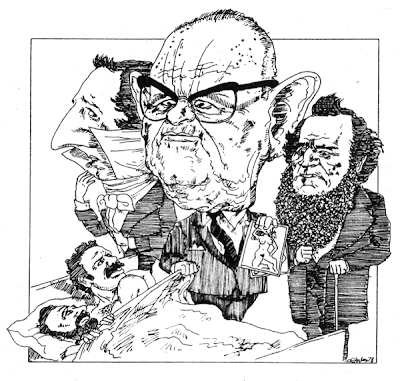
Cartoon of LDS President Spencer W. Kimball, flanked by Joseph Smith and Brigham Young, attempting to "cure" two homosexual men

In the 1970 LDS Church president Spencer W. Kimball (revered by the LDS as the prophet of God at the time) in his book “The Miracle of Forgiveness” lamented the fact that in many places homosexual was not longer a crime punishable by arrest and imprisonment; he wrote that for those who engaged in homosexual acts, it would have been better that if they had never been born.


Gay LDS Church member D.J. Thomas (above)
committed suicide in Arizona in 2000.

Since that time the suicide of numerous homosexual Latter-day Saints—distraught over their inability to change their sexual orientation—have been reported in the news.


Gay LDS Returned Missionary Stuart Matis committed
suicide on the lawn of an LDS Chapel


In 2000, faithful LDS Church member and returned missionary Stuart Matis shot himself through the head on the front lawn of the local LDS chapel in Santa Clara, California. Matis left a suicide note blaming the suicide on the conflict between his religion and his sexual orientation, a conflict that was accentuated by the battle over California's Proposition 22.


Russell Henderson (above) was an LDS Aaronic Priesthood


holder when he murdered Matthew Shepherd in 1998


Most famously, Russell Hendersen—one of the two young men who, in the 1998, murdered gay college student Matthew Shepherd—was LDS and ordained to the Church’s Aaronic Priesthood.

More recently, speeches and public rants given by church members who headed the Church’s campaign for Proposition 8 equated homosexuality with bestiality, incest and the sexual abuse of children. The Church declares that homosexuality is something that can be overcome through conversion, prayer, fasting and “obeying God’s commandments”—by which they mean the dictates of the current LDS Church authorities. The Church continues to demonize homosexuals—presenting them as sinister agents under the influence of the devil who are out to destroy the institution of the family.

Over the last two years, LDS Church members have been told by Church General Authorities (who are revered as being the sole representatives of God on earth) that they should forbid adult homosexual children and relatives to bring their partners into their homes. Their fear is that if LDS children or youth are allowed socialize with homosexual relatives and their partners, they will begin to see homosexuals as normal, ethical, happy individuals. More than any other religious denomination in the United States, the LDS Church continues to take increasingly drastic steps in stigmatizing homosexuals.


Utah Senator Chris Buttar


Just two weeks ago LDS Church members serving in the Utah state legislature showed every thing from indifference to vicious contempt when law-abiding homosexual Utahan presented a plea to state representatives to find some common ground for addressing the issue of same-sex civil unions. At the same time, Utah State Senator Chris Buttar (a devout LDS Church member--pictured above) said that gay and lesbian rights activists are "probably the greatest threat to America going down." He also asked "what is the morals of a gay person? You can't answer that, because anything goes. So now you are moving toward a society that has no morals." Buttar also compared gay rights activists to Islamic radicals: "Muslims are good people and their religion is anti-war. But it's been taken over by the radical side. And the gays are totally taken over by the radical side."


TE LDS CHURCH AND SO-CALLED “TRADITIONAL MARRIAGE”

Since the 1940’s, the LDS Church has gone out of its way to distance itself from its polygamous past. LDS General Authorities, historians and apologists never miss an opportunity to declare that the LDS ended polygamy in 1890 (actually it was 1904), and that it has excommunicated any member even preaching the doctrine since that time. (Actually such excommunications didn’t begin until 1907. They were aimed only at Church members who entered polygamous marriages after 1904.)


Heber J. Grant, who died in 1945, was the last


polygamist to serve as President of the LDS Church


The LDS Church does not advertise the fact that until 1945 every LDS Church president (each regarded as an infallible prophet) was a practicing polygamist. President Heber J, Grant, who died in 1945, was actually the Church’s last polygamist prophet with three wives. Into the 1950’s there were elderly LDS Church members who were polygamists. This means that the LDS Church has only been polygamist-free for about 50 years. This is quite a different picture than the one painted by the LDS Church in it’s official announcements, literature and press releases—all of which insist that the Church had been polygamist-free for nearly 120 years.

Even today LDS Church members, in LDS Temples, can be sealed (married) to more than one spouse “for time and all eternity.” This means that even though a Latter-day Saint can only have one wife at a time in this life, the Church continues to teach that in eternity (in “heaven”) he will be married to all the women to whom the Church has sealed him in their wedding ceremonies. Many modern LDS men—including quite a few modern General Authorities of the Church—believe that they will be polygamists in heaven.

Despite its current theology, the LDS Church continues its work to deny homosexual Americans of their civil rights—all in the name of defending “traditional marriage.”

THE LDS CHURCH & THE FLDS CHURCH HAVE THE EXACT SAME THEOLOGY REGARDING SEX

On the surface, the politically right-wing LDS Church and the radical FLDS Church seem worlds apart; like two completely different religions.

This is not the case.

Regarding the purpose of marriage and sex, the LDS and FLDS Churches embrace the exact same theology. The LDS Church opposes civil rights for homosexuals on the same theological ground that the FLDS Church has sanctioned polygamous marriage to underage teenage girls.

THE LDS/FLDS THEOLOGY OF SEX

Both the LDS and FLDS Church share a common theology regarding sex.

According the LDS and FLDS doctrine, God commands that all human beings must “be married for time and all eternity” in order to reach the highest degree of glory in heaven—Celestial Glory. A human being who reaches this degree of glory will become a God or Goddess.

As Gods and Goddesses, they will sexually produce spirits for future human beings who will be born on futures worlds that will be created. In LDS and FLDS theology, not only marriage, but heterosexual sexual intercourse itself and reproduction are pre-requisites for Godhood. According to LDS theology Godhood itself is the ability to engage in heterosexual sexual intercourse and reproduction for all eternity.

Since 1852 the LDS Church has taught that God (Our Heavenly Father) is married, and that our spirits (the part of us that will live on after death) were begotten through God’s sexual union with a Heavenly Mother. Until recent decades LDS Church authorities taught that God was a polygamist with many Goddess wives. Though the LDS Church no longer preaches this doctrine publicly—as does the FLDS Church--neither has it officially denied the doctrine.


In its recent statement concerning “the divine institution of marriage” the LDS explicitly has said that love is not the basis of marriage. Instead the Church insists that the purpose of marriage is reproduction and caring for children. Likewise the FLDS Church insists that the basis of marriage is not love. These views are a continuation of the LDS Church’s teaching in the late 1800s, which was usually articulated in this way: “We consider [romantic] love to be a false emotion.”

Both the LDS and FLDS Churches teach that marriage is commanded by God; that to fulfill God’s purpose for humanity (that is, to become Gods ourselves) every human being must get married and reproduce—in this life if possible, but most certainly in heaven. One’s future power and glory as a God will be based on the number of “spirit children” one has in eternity.

In the theology of the LDS and FLDS, heterosexual sex is the means by which one becomes like God and enters into heaven’s highest degree of glory.

No wonder the LDS Church is so vicious in its attacks on homosexuality.

BUT DID JOSEPH SMITH—MORMONISM’S FOUNDER—ACTUALLY TEACH THESE IDEAS?

The LDS and FLDS Churches each claim to be “the only true and living church on the face of the whole earth.” Each claims to perfectly teach the doctrines of Mormonism’s founder, Joseph Smith.

But did Joseph Smith actually teach the doctrines described above?

Did Joseph Smith teach that our spirits were begotten by Our Heavenly Father and Heavenly Mother?

Did Joseph Smith teach that one became like God through getting married?

Did Joseph teach that human beings, once they became Gods, would sexually begat spirit children for future worlds?

The answers to all three of these questions is NO.

These ideas are found nowhere in Mormon scripture—not in the Bible, “The Book of Mormon,” The Doctrine and Covenants, or “The Pearl of Great Price.”

These ideas can not be found in any of Joseph Smith’s letters, journals or sermons.

How is it that the LDS and FLDS Churches—the two institutions that claim to teach the doctrines of Joseph Smith—base their entire theology on ideas that Joseph never taught?

Joseph Smith--the founder of Mormonism--in 1843

And if Joseph Smith never taught these doctrines, how should devout Mormons who happen to be homosexual react to the LDS and FLDS Churches?

Can one be a Mormon without being a member the LDS or FLDS Church?

WHERE DID THESE IDEAS COME FROM?

Where did these ideas—the central concepts of LDS/FLDS theology—come from? Who came up with these ideas? If Joseph Smith didn’t teach these ideas, then who did?

THAT will be the focus of our next installment.

We will reveal exactly who invented this theology of married Gods and Goddesses sexually begetting the spirits of human beings.

We will reveal why, in 1852, Brigham Young and the LDS Church embraced these ideas.

We will then reveal exactly what Joseph Smith DID teach regarding the origin of the human spirit and the process by which human beings might progress to Godhood.

We will then reveal Joseph Smith’s vision of humanity once it achieved Godhood—a vision that he declared publicly in plain language—and a vision which the LDS Church ignored in the 1850s and then began to suppress and deny in the 20th century.

We will show that the actual teachings of Joseph Smith in his famous last sermon—the King Follett Discourse—actually undermine the LDS and FLDS theology regarding human sexuality. In light of this we will ask you to consider the following: When one considers what Joseph Smith actually did teach at the end of his life, is it possible that, strictly speaking, the modern day LDS Church isn’t even “Mormon?”

Finally we will present the Reform Mormon theology of human progress, marriage and sexuality.

This theology—founded firmly upon the principles of Joseph Smith’s unfinished Nauvoo-era reformation of Mormonism—is one that embraces all people— regardless of their sexual orientation. It reveres the worth of the individual, human freedom, intellectual curiosity, human progress and achievement. It exalts in human joy, and it embraces humanity and life on earth in a spirit of generosity and hope.


SHARE YOUR THOUGHTS


Is this all new to you? Do you find these ideas exciting…or revolting….or inspiring? Feel free to share your ideas, your insights and your questions with us. Email us at: reformmormons@aol.com

Wednesday, December 31, 2008

HAPPY NEW YEAR!


"Watch Night" was a religious celebration of New Year that began with the Moravians--a small European Christian sect of the 18th century who, among other things, emphasized the feminine aspects of God's character.

In the first decades of the 1700's, John Wesley began worshipping with Moravians, and his experiences with them inspired him to begin the movement now known as Methodism. Methodists took the Moravian traditon of "Watch Night" and made it a continuing part of Methodist tradition.(Just as Wesley had his first deeply felt religious experiences while attending Moravian worship services, so Joseph Smith--the First Mormon--has his first deeply felt religous experiences when in his mid-teens he began worshipping with Methodists in Palmyra, New York.)

"Watch Night" was celebrated on New Year's Eve, and it focused on the spiritual progress one made during the past year while encouraging one to recommit to personal spiritual growth in the coming year.

To celebrate "Watch Night," John Wesley's bother, Charles Wesley, composed a number of hymns. (Charles Wesley was one of world's greatest writers of hymns, and many of his hymns have become a traditional part of Mormon worship--appearing the hymnals of most Mormon denominations. Charles' most famous hymn is "Hark! The Herald Angels Sing.")

The following hymn is one of Charles Wesley's "Watch Night" hymns. It is printed here in the spirit of the holiday season:


"Come, let us anew our journey pursue,
Roll round with the year,
And never stand still till the Master appear,
His adorable will let us gladly fulfill,
And our talents improve,
By the patience of hope, and the labor of love,
By the patience of hope, and the labor of love.


"Our life is a dream; our time, as a stream,
Glides swiftly away,
And the fugitive moment refuses to stay,
The arrow is flown, the moment is gone;
The millennial year
Rushes on to our view, and eternity's here,
Rushes on to our view, and eternity's here.

"O that each in the day of His coming may say,
'I have fought my way through;
I have finished the work Thou didst give me to do!'
O that each from his Lord may receive the glad word,'
Well and faithfully done!
Enter into My joy, and sit down on My throne!''
Enter into My joy, and sit down on My throne!' '

--Charles Wesley (Hymn 217 in the current LDS Hymnal)


HAPPY NEW YEAR!

Sunday, December 21, 2008

Merry Christmas!


"I Heard The Bells On
Christmas Day"

I Heard the Bells on Christmas Day
Their old familiar carols play,
And wild and sweet the words repeat
Of peace on earth, good will to men.
I thought how, as the day had come,
The belfries of all Christendom
Had rolled along the unbroken song
Of peace on earth, good will to men.
And in despair I bowed my head:
"There is no peace on earth," I said,
"For hate is strong and mocks the song
Of peace on earth, good will to men."
Then pealed the bells more loud and deep:
"God is not dead, nor doth he sleep;
The wrong shall fail, the right prevail,
With peace on earth, good will to men."
Till, ringing singing, on its way,
The world revolved from night to day,
A voice, a chime, a chant sublime,
Of peace on earth, good will to men!

Henry Wadsworth Longfellow, 1867


MERRY CHRISTMAS &

HAPPY NEW YEAR!


Saturday, November 01, 2008

WHAT ALL OF US KNOW: Exploring the Mormon Paradigm--Lesson 2

WHAT YOU KNOW CAN SAVE YOU

“Knowledge is what saves a man.”—Joseph Smith, the First Mormon

Knowledge is what saves us, while ignorance or a denial of the facts, of truth, usually puts us at risk and peril.

The person who hasn’t learned how to swim is in danger of drowning; the person who knows how to swim is less at risk should she suddenly be caught in a flood or undertow.

The person who knows how to plant, cultivate and harvest—who knows how to hunt or fish is better equipped to avoid starvation. Without this knowledge, human survival is threatened.

Someone who discovers a tumor on his body but then continues on in denial of this knowledge, never seeking the advice of a physician puts his life at risk.

Ignorance of the facts—be it willful or unintentional—threatens human life, human progress and happiness.

THE TRUTH WILL SET YOU FREE

“Ye shall know the truth, and the truth shall make you free.” (John 8:32)

All religions claim to possess “the truth.” Most religions claim that if one will come to “know” the “truth” that they teach, one will be saved—from the woes of this life, or from damnation, suffering or loss in an afterlife.

The problem is that many of the “truths” proclaimed by most religions are principles that are supported by little if any objective evidence. Many of these so-called truths are faith-based principles that fly in the face of objective reality. Because of this, the type of “knowledge” that these religions champion requires a huge amount of blind-faith, denial of rational thought, compartmentalized thinking and self-deception.

Traditionally religions have issued broad declarations of a supposed truth regarding the nature of reality, and then have encouraged believers to deny or explain away any evidence that contradicts that declaration. For instances, a Biblical fundamentalist will declare that the heavens and the earth were created, a mere six or seven thousand years ago, in six days; that at that time God created human beings in their present form. A fundamentalist may claim to “know” that this is true. But when pressed such “knowledge” ends up be described as “spiritual” or mystical in nature; and this “knowledge” is maintained by denying and ignoring all of the physical evidence (and the scientific theories based upon that physical evidence) that the earth is, in fact, tens of billions of years old, and that all species of biological life (including humans) evolved from less complex life forms.

In short, traditional religions—while claiming to champion knowledge and truth—actually end up devaluing both.

The Mormon Paradigm is different.

Knowledge and truth are deeply revered by Reform Mormons—in fact, Mormon scripture equates the two concepts: “Truth is a knowledge of things as they are, and of as they were and of as they are to come.” (The Doctrine & Covenants 93:24)

In the Mormon Paradigm truth IS a knowledge of the facts regarding existence. The Mormon definition of “truth” is the same definition used by secular thinkers and rationalists. For Reform Mormons blind faith, mysticism and a belief in the supernatural are not required to understand truth. In fact from the Reform Mormon perspective, blind faith, mysticism and devotion to supernaturalism can actually undermine one’s knowledge of the truth.


FIRST THINGS FIRST

Rather than beginning with broad declarations concerning the nature of God or the supernatural, the Mormon Paradigm begins by examining those things that ALL human beings can know objectively by virtue of their physical senses. The physical senses are the means by which human beings obtain information concerning one another and of the world in which we live, and rational thought is the means by which humans understand that information. As Thomas Jefferson declared, “Every man’s own reason must be his oracle.”

For a religion to be valuable to human beings—for that religion to inspire, encourage and cultivate human progress and joy—it cannot preach faith-based ideas that contradict what we all know to be objectively true by virtue of our physical senses.

So let’s begin our examination of the Mormon Paradigm by considering first those things that we can all agree are true—those facts upon which all of us (followers of a particular religion and atheists alike) can agree.


WHAT WE ALL KNOW

Consider the following ideas, taken from a classic work of Mormon theology: B. H. Roberts’ monumental study, “The Truth, The Way, The Life.”


“Man knows himself as existing. He is a self-conscious entity. He knows himself as existing by many manifestations. He knows himself as seeing, hearing, tasting; as feeling…But most of all in all these manifestations through which man attains self-consciousness, he knows himself as thinking: “I think, therefore I am.”…One thinks, and one acts; therefore one is.

“And not only is one conscious of one’s self, but he is also conscious of other selves, of other men, such as he himself is, in the main; with the same kind of qualities which he himself possesses…”

“One’s knowledge is not limited to this consciousness of self and other selves—to the likeness and the difference between himself and other selves. He is conscious of the existence of a large external world. He knows the existence of earth; land, water, and air. He knows the earth is divided into islands and continents, seas and oceans, rivers and bays. He knows the existence of the town or hamlet or countryside where he was born…he knows, at least by report, of the great centers of world population….”

“Man knows objects by form, texture, and quality…. [But] man’s knowledge [is not] confined to material things. He is conscious of qualities, even of intellectual and moral qualities….He has a mind capable through the imagination of creating worlds and peopling them with creatures of his mind…”

“Man knows himself as competent to form normal judgments and realizes self-responsibility for his actions…He is capable of forming comparisons between moral states and conditions…

“…passing things in review and pronouncing judgment upon them as good or evil, better or worse, man becomes conscious of a very wonderful power that he recognizes as existing within himself: the consciousness of will; the power of self-determination; the power to choose which of two or more courses he will take. He can do as he wills to do. While there may be persuasive influences drawing him to one side or the other, yet he is conscious of the power to determine what his action shall be. He recognizes the truth avowed by the English poet [Shakespeare], “It is in our Wills that we are thus or thus.” This is not to assert man’s powers to do impossible things, especially impossible physical things…I have had in mind rather the fact of free moral agency, man’s power to recognize good and evil by their effects in human life, and his power to choose between them—to choose which he will follow.”

(B. H. Roberts’ “The Truth, The Way, The Life: An Elementary Treatise on Theology.” 2nd edition, pp. 29-32)


(Above: B. H. Roberts--Mormon Theologian)


In coming lessons we will explore the Mormon Paradigm building upon the following facts:

--I think, therefore I am.

--I know that I share a common nature with all other human beings; in nature, we are all alike.

--I know that I exist in a physical realm. I gain my knowledge of world around me by virtue of my physical senses.

--As a human being, I have a level of natural intelligence that allows me to remember, to imagine, to think in terms of good and bad, to think abstractly, to make value judgments.

--Because as a human being I can make value judgments, by nature I am free to make choices; I am free to act on my own judgments.

--Because I am free to act based on my value judgments and choices, I must take responsibility for my actions and accept their consequences.


SOME MEMORABLE QUOTES


“Ye shall know the truth, and the truth shall make you free.”—Jesus of Nazareth (John 8:32)

"Truth is a knowledge of things as they are, and as they were, and as they are to come.”—Joseph Smith (Doctrine & Covenants 93:24)

“Knowledge is what saves a man.”—Joseph Smith (The King Follett Discourse)

“Every man’s own reason must be his oracle…[God has bestowed] reason... as the umpire of truth.”—Thomas Jefferson

“I think, therefore I am.”—Descartes (from “Discourse on Method”)

“It is in our Wills that we are thus or thus.” –Shakespeare (paraphrase of “Othello 1.3.319-20)


(Left: A recently discovered 1843 photograph, reported to be the only photograph ever taken of Joseph Smith--the founder of Mormonism.)

GET INVOLVED IN OUR DISCUSSION

Do you have any thoughts on this lesson---any ideas you’d like to share? If so, we will post them here. Email to us at: Reformmormons@aol.com

In consideration of space and clarity, we reserve the right to edit any email we may post. All view points will be welcomed.

Sunday, October 26, 2008

PARADIGM SHIFT: Mormonism's New Paradigm


When it comes to religion, the world is in midst of a monumental paradigm shift.

There is an overall concept regarding the nature of God, the universe and man that most people have accepted without question for nearly 2,000 years. If someone is religious, it’s assumed that he or she accepts that overall concept—that paradigm.

It seems virtually impossible to have any discussion on religion without having everyone involved in the discussion accepting the following ideas:

1. There is only one all-powerful, all-knowing God who created and controls all things. Some may define God in personal terms: as a Father or Mother, as an Almighty Lord or Heavenly King, as Jesus Christ or some other human figure from history or myth. Others may envision God as an impersonal Force, Power or Spirit. Regardless of how God is defined, most people tend to believe that there is but one God who is above all things that exist, who is the “First Cause” of all that exits.

2. The cosmos, the universe—everything that exists—has a definite beginning. Some may believe that the universe was created by God in seven literal days. Others may believe the earth was created in seven thousand years, or over the course of billions of years. Some think that existence began with a Big Bang. Despite differences regarding how existence began, all seem to agree that existence did have a beginning; that at some point nothing existed, and then existence itself began.


3. Human nature is inherently conflicted. Many believe that the physical body with its appetites and desires is in conflict with an immaterial spirit or soul; they may talk about “Original Sin,” and humanity’s inherent “sinful nature.” Others think of the conflict in terms of emotion versus reason, the heart versus the head. Still others consider the concept of the individual, as well a person’s self-interest or selfishness to be in conflict with the “greater good” of the masses and of selflessness and sacrifice. Still others pit the human tendency to question things and to demand evidence or proof against the human ability to accept ideas on the basis of faith alone. Regardless of exactly how the conflict is described, all religions tend to view human nature as inherently conflicted and therefore in need of change, redemption or salvation; human nature is defected and one particular religion has the remedy.

4. There is an external authority—separate from, and at times at odds with human reason, knowledge and understanding—which determines was it right and wrong, true and false, good and evil. Some believe that authority is God Himself, speaking or issuing commandments through a certain book of scripture, a particular church or religious organization, a certain group of human beings or a particular religious leader such as a pope, a guru, a priest or prophet. To cling to one’s own ideas (as rational at they may seem) instead of accepting whatever revelations or commandments may come through these sources is to reject not only God himself, but the very foundation of morality. Others may reject such visible symbols of external authority as scripture, churches and religious leaders—instead teaching that man must put aside his rational mind, his demands for evidence and proofs, and the conclusion he has reached regarding the nature of things; man must forsake his ego—his sense of self—and open himself up to God, to the Light, the Source of all things, the Spirit of the Universe, etc. Only through submitting to a mystical inner communion with the Divine, can man “be freed” from the pain, suffering and evils of life on earth. Regardless of how submission to an external authority is envisioned, the over-all idea is the same: ethics, morality, piety, virtue, holiness and righteousness consist of putting aside one’s rational mind, one’s own ideas of things, and submitting to an external authority.

5. After this life a person’s spirit receives some sort of eternal reward or punishment. Some believe this reward or punishment is the result of one’s deeds. Others believe it is determined by the religion one embraced in life, the God in which one had faith, or the church to which one belonged. Still others believe that one’s eternal reward or punishment is determined by the type of person one became as a result of how one lived his or her life. Regardless of how the reward or punishment is determined, the overall belief of most people is that after this life, one’s spirit passes on to am eternally fixed and static state. One is either saved or damned; one goes to either heaven or hell; one achieves nirvana or one does not.


For nearly two thousands years, the world has tended to accept (or to at least give lip-service and deference) to these ideas—to this religious paradigm.

However, over the past six hundred years (beginning with the Renaissance in Europe), individuals have arisen who have questioned aspects of this paradigm. Science and medicine have brought forth new knowledge regarding the universe, nature, the human mind and body.

The scripture and sacred writing of most religions came forth hundreds or thousands of years ago when people in their ignorance believed the earth was the center of the universe around which the sun, moon and starts revolved.

It was assumed that disease and natural disasters were sent by Gods, angels or devils to punish, chastise or humble disobedient and impure human beings. There was no concept of germs, bacteria or viruses; no understanding weather patterns or geological forces at work beneath the surface of the earth. People had no concept of impersonal natural forces causing events or spreading disease. If a disaster struck an area, if a plague or disease ravaged a particular community, then a God or supernatural being must have caused these things to happen.

In short, most scripture and religion came hundreds or thousands of years ago before the human race had developed an understanding of nature itself.

Over the past six hundred years that has changed.

We know now that the world is round, not flat.

We know that the earth is not the center of the universe. In fact, we now know that the universe actually has no center at all, but seemly extends onward and outward in all directions eternally.

We know that disasters and disease are the result of impersonal forces in nature. When wondering if a storm or earthquake might strike a particular area, people no longer turn to shamans, holy men and seers; they consult the scientists who study these natural phenomonans. Where ancient might have turned to oracles or priests for prophecies concerning coming storms or calamities, we now turn to TV meteorologists and weather reporters.

When a loved one is taken ill, witch-doctors and faith-healers are not consulted; most people don’t sacrifice animals on an altar in an attempt to convince gods to heal them. Again scientists (in this case, medical doctors) are called for advice.

When someone suffers from depression or emotional disorders, most people no longer hire an exorcist, or recite magical incantations in an attempt to drive away demons and evil spirits. Instead they turn to medical experts such as psychologists or psychiatrists.

In the modern Western world most people, regardless of how much they might believe in one all-powerful God, still maintain that individual human beings have certain natural rights upon which not even religion may infringe. Most modern nations have made an attempt to separate the powers of organized religion from the power of government. Whereas the ancient people who brought forth the world’s scriptures and religion had no concept of the individual have a right to life, liberty and the pursuit of personal happiness, most modern people consider these ideas to be sacred.

Whereas ancient people believed that gods had every right to demand that an individual lay down his or her life, modern people consider human sacrifice to be an abomination. (For Jews and Christians, one of the most troubling stories in their Bible is the account of God commanding Abraham to sacrifice his son Isaac.) Ancients believed it was honorable and right to execute heretics, adulterers, prostitutes, and children who dishonored their parents and families. While many modern people may consider heresy, adultery and prostitution sinful—even criminal in some cases—most would never assume that these things warranted public execution.

Despite all the progress achieved in our understanding of the universe and in our respect for human nature, most people still cling to an ancient religious paradigm—a religious “scheme of things”—that is at odds with nearly every aspect of modern life.

In short, we are in the middle of a monumental paradigm shift when it comes to religion.

That paradigm shift is the defining aspect of our age. One needn’t look any further than the morning paper, the evening news or current political and military events:

—The so-called “War on Terrorism” being waged by the United States and her allies is not so much a war on terrorism in general but a war against theocratic forces from Islamic nations who condone violence in order to defeat “infidels” and establish submission to what they believe is God’s will.

—In the United States, many Christian fundamentalists decry “secular humanism,” and insist that there should be no “wall of separation between church and state.” They insist that the United States was founded on “Biblical principles” and that such “sins” as homosexuality, pornography, no-fault divorce and abortion should either be declared illegal or in some way stigmatized by the law.

—Religious fundamentalists campaign to have ‘Creationism” and “Intelligent Design” (the doctrine that God created and designed the universe) taught in public school science classes along side the Theory of Evolution and Natural Selection.

—While a greater portion of the United States population than ever before defines itself as Evangelical Christian (a high as 32% according to some polls), and while this segment of the population influences politics and government more profoundly than at any time in American history, these same Evangelicals nevertheless continue to see themselves as a persecuted minority whose rights are being attacked.

—Some of the best-selling books of the past few years have been in-depth defenses of atheism and attacks on traditional ideas of faith and believe. Such books as “God Is Not Great,” “The End of Faith” and “The God Delusion” are the works of some of the most respected thinkers of our day—and they have all become best-sellers. On the other hand, the best-seller lists also have included works such as “The Purpose Drive Life” (by a conservative Christian minister) and the current best-seller “The Shack” (written by a liberal, non-traditional Christian theologian.)

—For decades now people who have an intense interest in religion and in ethics but who are not fundamentalists describe themselves as being “spiritual” as opposed to “religious.” Why? Because the majority of the population tends to view organized religion negatively; they equate it with fundamentalism, legalism, self-righteousness and bigotry. Despite this negative view of organized religion, these self-described “spiritual” people embrace many of the core ethics of traditional religion: love of neighbor, caring for those who need, defending the oppressed and outcast. And sadly enough, many of those who are most vocal in attacking the “bleed-heart liberalism” of these “spiritual” people are those who define themselves as “religious.”

Why is there some much contention over religion? Why the discord?

Certainly the history of religion generally is in large part a record of contention, discord and violence. But in our day something has changed.
The human race has simply reached a point in its progression where the religious paradigm of the past four two to four thousand years can no longer be taken literally; the paradigm—what we have been told we should believe about the nature of reality—is simply out of harmony with what we actually know about the nature of reality.

Reform Mormons embrace a new religious paradigm—what we call “the Mormon Paradigm.”

The Mormon Paradigm completely rejects the following ideas found in the traditional religious paradigm:

1. The Mormon Paradigm rejects the belief that there is but one all-powerful, all-knowing God. Its understanding of God’s nature is completely different from that of all other religions.

2. The Mormon Paradigm rejects the belief that the universe and the existence ever had a beginning. It completely rejects the belief that there was ever an “in the beginning.” It rejects the doctrine of Creationism.

3. The Mormon Paradigm rejects the belief that human nature is inherently fallen, sinful or conflicted. An idea such as Original Sin has no place whatsoever in the Mormon Paradigm.

4. The Mormon Paradigm rejects the belief that morality consists of obeying or submitting to any external authority such as a book of scripture, a set of laws, the commands of a religious leader, the decrees of a religious organization or tradition, or an external spirit, power or force.

5. While believing that everything and everyone has an eternal aspect, the Reform Mormon Paradigm completely rejects the belief in a static life after death—either in heaven, hell or limbo.

From now on, this blog will explore that Mormon Paradigm in depth. We will explore how the Mormon Paradigm views things from the tiniest microscopic element to nature of God—and everything in between.

Why?

Because if one’s religious beliefs concerning any aspect of reality are out of harmony with what is known about reality (known by virtue of one’s senses, by virtue of objective physical proof, by virtue of sound reasoning), eventually trouble will be the result. If one’s ideals are out of harmony with objective reality and with human nature as it now is then eventually—in the name of those so-called ideals—human nature (and human beings) will come under attack.

Recently agnostic, religious skeptic and comedian Bill Maher said, “My theory is, if there is a God, He needs a break….we don’t know if He exits. But if there is a God, He is very put upon. He wants someone to debunk. Leave Him alone already. Keep the pressure off of Him.” ( Quoted in “USA Today,” October 6, 2008)

No one can argue that the religious paradigms of the past have inspired injustice, tyranny and violence in the name of God. God has gotten a “bad rap”—the most offensive being from those who have claimed to be his most devout followers and defenders.

To use the words of Maher, the New Religious Paradigm of Reform Mormonism “debunks” the false ideas, the irrational theologies and the silly superstitions that traditional religions have put forth regarding the nature of God, man and the universe.

And beyond this, Reform Mormonism’s New Religious Paradigm puts forth a theology a mythology, a philosophy and a set of ethics and values—the purpose of which is to exalt human beings and human life here on earth.

Thursday, July 03, 2008

FREEDOM

Concerning what is sacred, often I’m alone:
Set apart from other men; a sect all my own.
Pious men of good report assume that I’ve no God
Because the path I’ve chosen is not the path they trod.

But I have a god—though not the God of most:
No distant king, or vengeful Judge, or angry Lord of Hosts.

The glory of my God is everywhere revealed,
In burning sun, in languid moon, in heaven, sea and field;
In every law which keeps the earth and all things in it bound
The mind of my most gracious God is waiting to be found.

And man—of all God’s creatures—can learn his grand design,
so in the name of nature’s god, I hold this truth divine:


Free each man was born,
And free each man remains
Though he’s beaten and he’s torn,
And weighted down in chains.
In the strength of his convictions
He can stand before the crowd:
His heart beats free
And his head remains unbowed.

For there’s something in a man
That should not be denied—
Though it’s often sacrificed,
And for its sake men have died,
Paying the ultimate price.

Let persecutions come,
Let calumny defame;
The cause of human liberty
Flows onward unrestrained;
Should other voices fail,
I will sing strong and loud:
“My heart beats free!
My head remains unbowed!”


Classical Mormon theology puts forth a radical doctrine of human Free Agency: the mind of man is eternal, uncreated and co-equal with God. Freedom is not a gift from to humans; it is not the creation of God. Rather freedom is inherent in the very nature of man.

Because of this, Reform Mormons value the freedom, independence and individual agency.

Share your thoughts on freedom with our readers. Email them to: reformmormons@aol.com

Sunday, June 22, 2008

REFORM MORMONISM & MARRIAGE

This past week California joined Massachusetts in legalizing same-sex marriage. Two weeks ago the governor of New York ordered all stage agencies to recognize same-sex marriages performed in other states and nations. So it is that in the past week legally recognized same-sex marriages have become a reality in three of the most populated states in the U.S. At the same time this week, new scientific findings were released by the Karolinska Institute in Stockholm, Sweden on differences in the size and structure of the human brain in heterosexual and homosexual subjects. The findings offer yet more medical evidence that sexual orientation is not the product of personal choice or social influences but is an inborn biological trait, as immutable as height, gender or race.

Eventually all religions that have taken a stand against homosexuality and same-sex marriage will have to address the issues raised by these developments in law and science. In response to these events, this week’s Gospel Doctrine Lesson will address the Reform Mormon view on the meaning and purpose of marriage.

During the last half of the 19th century and the first decades of the 20th century, Utah Mormons found themselves, politically and socially, in the same situation that activists for same-sex marriage now find themselves: attacked for being “anti-family,” for being enemies to “traditional marriage,” and for being a threat to everything from Christianity to Western civilization itself. (Given its own history, it is ironic—to say the very least—that the LDS Church is one of U.S.’s most vocal and active agitators against same-sex marriage. Days after the California Supreme Court’s decision, it was the state of Utah that officially petitioned California, asking that no such marriages be performed until after an amendment to the state’s constitution—overturning the court’s decision—could be voted upon in the upcoming election.)

Almost from its inception, Mormonism diverged from popular and traditional views on marriage. In 1831, at a time when most white racism against Native Americans was nearly universal, Joseph Smith encouraged Mormons to form “matrimonial alliances” with the Indians of the American mid-west. By the mid-1830’s, Mormons were being accused of practicing polygamy. In the early 1840’s as the strict sexual mores of the Victorian Age were being embraced by Americans, Mormons were publishing religious tracts denouncing “monkish” attitudes toward human sexuality and teaching as a theological principle that sex was essential to human joy and happiness. In the early 1850’s, Mormons in the Territory of Utah instituted the most liberal divorce laws in the United States. (It would take the rest of the nation more than a century to catch up with the pioneer Mormon practice of no-fault divorce.)

With this history in mind, we will explore the Reform Mormon concept of marriage.


"It is not good that man be alone, for we are not alone." (Eloheim speaking to Jehovah in the pre-1970 LDS Endowment ceremony)

As Christianity was the official religion of Europe for over a thousand years, it makes perfect sense that the ideas of most Westerners regarding marriage descend from the Biblical creation myths. Mormonism itself evolved from 19th century American popular religion which was rooted in the Biblical traditions.

Biblical fundamentalists, Evangelicals and LDS Mormons currently argue that reproduction and the rearing of children is the main purpose of marriage. Yet none of these groups discouraged marriage among infertile or elderly heterosexual couples, or among young, fertile heterosexual couples who chose not to have children. They argue that because these couples could biologically reproduce if they were fertile, younger or disposed toward parenting, they should be allowed—even encouraged—to marry.

The idea that reproduction is the main purpose of marriage (indeed, of sex itself) comes from a literal reading the first creation myth—the Israelite creation myth found in he first chapter of Genesis.

According to the Israelite creation myth, God (Elohiem) creates the heavens and earth in six days. On the sixth day, after creating all forms of sea-life and animal life on earth, God last of all creates a nameless man and woman in his image. (Nowhere does the Israelite myth explain how God creates man and woman; there is no mention of creating them out of the dust of the earth.) God blesses the man and woman, commanding them to “be fruitful, multiply and replenish the earth,” and to exercise dominion over all forms of life on earth. (See Genesis 1:26-31)

But a completely different creation myth—this one the product of another culture altogether, the Judean culture of southern Israel—begins in chapter 2, verse 4 and continues through chapter 4 of Genesis. Strangely enough, Evangelicals, fundamentalists and the LDS usually quote (or misquote) the Judean myth—and blend elements of it with elements of the Israelite myth, the end result being that they distort what the Judean myth actually says.

The differences between the Israelite and Judean creation myths is striking—and once the differences have been noticed, one may be astounded that so many Evangelicals, Christian fundamentalists and LDS Mormons remain ignorant of that fact that the opening chapters of Genesis actually contain two different and contradictory stories.

The Judean creation myth is filled with details—familiar to most Christians, Jews and Mormons—that are not found in the Israelite creation myth. Among these important details is that the Judean myth gives actual names to all the characters. In the Judean myth the God who forms the earth has a personal name: Yahweh—which has traditionally been translated into English as “the LORD God.” Also the man and woman—who are nameless in the Israelite creation myth—are here given the names of Adam and Eve.

Also striking—and most important—is the plot of the story told: Yahweh makes the heaven and the earth, but no time frame is given for this. Nowhere is a period of seven days—or of seven time periods of any duration—given.

Rather than creating man and woman last and at the same time (as does the God of the Israelite myth), Yahweh makes the man—Adam—first before making any other form of life. After forming Adam from the dust of the earth, Yahweh breathes the breath of life into his nostrils so that Adam becomes a living soul and the very first life form on the planet earth. In contrast to the order even of events in the Israelite myth, Yahweh causes all plant life to grow out of the ground, and plants “a garden eastward in Eden” after the appearance of man on earth (See Genesis 2:4-15) (It should also be pointed out that the Garden of Eden plays no part whatsoever in the Israelite creation myth.)

At this point the only living things on earth are the plants and one lone man. Yahweh declares, “It is not good that man should be alone; I will make him an help meet for him.” (Genesis 2:18)

The phrase “an help meet for him” is usually misquoted as “a helpmate for him.” However the word “helpmate: and the phrase “an help meet for him” have two very different meanings. “Helpmate” means simply spouse. But “an help meet for him” means “a helper worthy of, or equal to him.”

What happens next in the Judean myth is surprisingly. In order to make “a helper worthy of, and equal to” Adam, Yahweh forms every fowl of the air and every beast of the field out of the ground. Yahweh then brings these potential helpers “worthy of and equal to Adam” to Adam so that he (Adam) can give them names. (See Genesis 2:18-20)

Birds and the beasts are Yahweh’s first attempt to make for Adam a “helper worthy of and equal to him?”

For the millions of people who have misinterpreted Genesis by using the word “helpmate” (spouse), this bit of the Judean myth could be troubling to say the least. If Yahweh’s intention was to make a sexual partner (a “helpmate,” a spouse) for Adam, why did He form birds and “the beasts of the fields?” What are we to make of this portion of the story—and of Yahweh’s apparent ignorance of the biological difference between a human male and say an eagle or a horse? (If one wanted to be facetious and outrage fundamentalists one could suggest that Yahweh first intended Adam to choose a bird or a beast as his sexual partner—that the Lord original intent was that bestiality be the sexual norm for humans. To suggest such a thing, however, one must accept the fundamentalist’s mistranslation of “help meet” as “helpmate.”)

Back to the second chapter of Genesis: Adam names all the birds and beast but alas, among all these newly formed life forms “there was not found a help meet for him.” (Genesis 2: 20) In other words, Adam became acquainted with the animals of earth, but impressive as many of these species were, he found that none of them were equal to him.

So next Yahweh causes a deep sleep to fall upon Adam, take from his side a rib and from that forms a woman—Eve. When Adam is introduced to Eve, he recognizes her as “bone of my bone, and flesh of my flesh.” (Genesis 2:23) Adam recognizes that Eve is like him; that they share a common biological nature.

What happens next? Does Yahweh command Adam and Eve to reproduce and multiply?
One would assume so if one listens to Evangelicals, Fundamentalist and LDS Mormons tell the story.

But this is not the case at all. In fact, reproduction is not mentioned until the fourth chapter of Genesis—after Adam and Eve eat the fruit of Knowledge, leave the Garden of Eden and are living on their own in the outside world.

Instead the next two verses of the Judean myth sum up the entire meaning of the story:

“Therefore shall a man leave his father and his mother, and shall cleave into his wife; and they shall be one flesh. And they were naked, the man and his wife, and were not ashamed.” (Genesis 2:23)

The central idea being explored in the myth is not reproduction but companionship, the union of two humans and intimacy.

There is a social stereotype (surely offensive to cat and animal lovers) of “the cat lover.” This stereotype would be the woman or man who has never known romantic love—who, in fact, has no close friends or relations, and lives alone in an apartment full of cats. Most people assume that a person who does not share his or he life intimately with another human, but instead builds a life around relationships with pets is someone to be pitied.

Why is this?

Because most people realize that as loveable and as affectionate as an animal may be, such a relationship is in no way comparable to an intimate, loving relationship with another human being.

Mormon scripture declares “the glory of God is intelligence.” (Doctrine & Covenants 93:36)

Human intelligence is of high order than animal intelligence. It is because of the nature of human intelligence, that we humans can even conceive of abstractions such as “love,” “hate,” “alone,” “together,” “me,” and “you.” These abstractions—universal to all human beings regardless of time, location, nationality, race or creed—form the foundation of all human relationships.

Regardless of the intelligence of other species, there is no evidence whatsoever than any other known life form on earth can consciously hold these abstractions in mind, act upon them, communicate them and react emotionally to them in the way as do humans. The affection of a pet for its owner is of a different nature than the love of one human for another because the intelligence of a pet is of a different nature than the intelligence of a human being.

Other species mate, reproduce, nurture their young, then leave their offspring to fend for themselves—before moving on to repeat the cycle again and again until their bodies age past the point of being able to reproduce.

But this is not the case with human beings.

We approach relationships (or run from them) with a keen sense of ourselves and of others as intelligent individuals. We are constantly observing and judging one another—not just on the basis of fertility or strength, but on the basis of higher abstractions such as kindness, cruelty, goodness, evil, justice and injustice. To borrow the symbolism of Genesis, these concepts—which only a highly intelligent life form can fully process—are the ground and the dust from which our emotions are formed. Among these emotions are those emotions related to sexual arousal. Art historian Camille Paglia has written that “sex is where nature and civilization intersect.” Regardless of how “animalistic” one might label a particular sexual act, sex for humans will always have a profoundly psychological and emotional dimension—and therefore a spiritual and ethical dimension—that transcends the reproductive role that sex plays in other species.

“…intelligence cleaveth unto intelligence…” (Doctrine & Covenants 88:40) can

When Adam is introduced to Eve in the Judean myth, he recognizes her as bone of his bone and flesh of his flesh. But a much deeper recognition seems inherent in this poetry.

Adam recognizes that here is another being who shares his level of intelligence. Here is another being who perceives him using the same processes through which he perceives her. Here is another being whose mind and emotions function in the same way; another being with whom he can communicate; another human being he known, and by whom he can be known. “Bone of my bone…flesh of my flesh…intelligence cleaving to intelligence.”

To reduce human sexuality and marriage to mere reproduction is to equate human nature with that of a barnyard’s four footed inhabitants; it is to debase marriage by equating it with the breeding practices of the stockyard.

And yet in the name of “protecting the sanctity and dignity of traditional marriage,” this is, in effects, what Evangelicals, fundamentalists and LDS Mormons do.

Consider again the last two verses of Genesis, chapter two: leaving one’s parents and uniting with another human being—this is the essence of marriage.

It is not good that a person be alone. A person needs to have a “help meet” for him or her. That means that each of us needs another being who, by nature, can experience life as we experience it, think as we think, feel the same type of emotions that we feel; another human being who can communicate to us what they think and feel; someone with whom we can communicate; someone with whom we can share the experience of living life on earth as an intelligent being.

Affection, closeness, nurturance, sexual arousal, physical pleasure—these are ends in and of themselves. Part of what makes us human is that by out nature we are able to conceive of arousal and pleasure and physical intimacy as separate ideas in and of themselves. Our nature as beings who exist in the image of God—who is also an intelligent being (see Abraham 3:18-19)—is revealed in our sexual nature.

The essence of marriage is companionship. In fact, marriage IS companionship of the most intimate nature.

Consider this: when do most people consider a marriage to be over?

One spouse may commit adultery, yet so long as the couple continues to live together we consider the marriage—though flawed—to be intact. One spouse may physically or emotionally abuse the other; we may consider the marriage dysfunctional, but so long as the couple continues on together, we still consider them married. The sex life of a couple may die, but so long as the couple are there for one another as companions, they are considered married.

Now consider this: a couple has had a fulfilling sex life; they have been faithful to one another; they share a common philosophy or faith; they may have children whom they love and nurture. But should one spouse dissert the other, should one leave and cease all communication; should one spouse simply not “be there” for the other when that spouse is facing illness or tragedy—should any of these situations exist, then despite their past history, despite the children they share, despite the blessing their union may have received from either church or state—most people would view the marriage as over.

Companionship, having “a help meet” for oneself—such is the essence of marriage. A commitment and covenant to such a relationship is the basis of marriage. Reform Mormons believe that marriage is a New and Everlasting Covenant between consenting adults; that because there is something eternal in the nature of human intelligence, the marriage and family relationship can extend onward beyond this mortal life; that the Holy Spirit of Promise—present when two individuals willingly and loving enter into the New and Everlasting Covenant of Marriage—will seal that union for time and eternity.

Concerning eternity, Mormon scripture states:

“..the same sociality which exists among us here will exist among us there, only it will be coupled with eternal glory, which glory we do not now enjoy.” (Doctrine & Covenants 130: 2)

The love of one spouse for another—regardless of gender—will continue because this kind of love is the product of human intelligence, and intelligence is an eternal attribute. Intelligence is the glory of God.

Reform Mormons believe that through marriage and family relationships, individuals may cultivate those virtues that are associated with God. The knowledge that we gain through out most intimate relationships with other humans is the knowledge that will ultimately exalt us and enable us to see things as God sees them. By fully immersing ourselves in these aspects of our humanity we become like the God in whose image we exist.

LDS and FLDS Mormons teach that marriage is essential for Godhood, but their theology is quite different from that of Reform Mormons. LDS and FLDS theology teaches that spirits are sexually begotten by a God and Goddess, and that the right to such divine reproduction will only be granted to those who are married for eternity. In other words, Godhood consists of being able to sexually reproduce in the next life.

What is surprising is the fact that this doctrine is taught nowhere in Mormon scripture; nor did Joseph Smith—Mormonism’s founder—ever teach this doctrine. In fact, Mormon scripture and Joseph Smith himself (in his famous King Follett Discourse) taught a theology on the nature of the human spirit that completely undermines such a doctrine.

(An earlier Gospel Doctrine lesson explores the history of this popular LDS and FLDS doctrine—showing how it was developed by Orson Pratt, after Joseph Smith’s death, as a theological justification for polygamy. To read this lesson, click on to our archives for the date of 10/17/04)

The LDS or FLDS homosexual who believes this theology can only get into heaven by prostituting his or herself. Such a person may go through a marriage ceremony, may have children, may cohabitate with a person of the opposite sex and give his or her self over to that person sexually—but the joy of experiencing mutual sexual attraction, of letting down one’s guard and communicating openly and honestly, of being secure that one is loved and desired for who one is; of desiring, wanting and valuing one’s spouse for who he or she is—these things which are essential to a truly happy marriage, these things they will never know.

The message of Reform Mormonism is that marriage should be available to all not because marriage is “the foundation of society,” but because the need for intimate companionship, the need for over-coming loneliness, to need to find “a help worthy of and equal to one’s self” is the essence of what it means to be human.


JOIN THE DISCUSSION
Do you have comments or insights on the subject being discussed here? Email them to us at: reformmormons@aol.com. Emails posted here may be edited for grammar or length.

Monday, June 16, 2008

CLASS DISCUSSION: "Truth, Sentimentality & Comfort Zones"

In response to this past weekend’s lesson, Fabien in Edinburgh, Scotland writes:

“What an amazing lesson! I totally subscribe to what is written in it! I remember reading a long time ago that Brigham Young claimed that all truths were Mormonism and I interpret this as saying that Mormonism was a quest for truth and knowledge of God and all he expected us to do to become like him in all kinds of ways. So all truths would be working hand in hand with Mormonism to make this possible.

“I liked the image of Adam and Eve returning to a Garden that would not be what they remembered it to be...

“I also liked the idea of searching for God no into some "imagined immaterial world" but in this existence, on this planet. When I consider God, when I reflect on eternal truths and the mysteries of my faith, I do not think of some outer space world à la Kolob but I think of my own nature, created in the image of God, and then I feel so close to this planet, to the grass I sit on, to the leaves in the trees around me. When I commune with God this is not a silent prayer in a building built for that purpose. It can be, of course, but most often it is me being outside in nature and I feel the eternal side of me and that eternal side of me communicates with the kindred eternal side of my God.

“Thank you for another great and greatly inspiring lesson!”


Fabien publishes his own excellent blog in which he explores not only Reform Mormon ideas and concepts but also currents topics and news events relating to Mormonism generally. It’s entitled “Sorta Reform Mormon(s).” Link to it by clicking on to: www.reform-mormon.blogspot.com

On the issues of "comfort zones" and fear of the unknown, Wilhelm in Germany writes:


"While reading through the posting, one thing jumped into my mind, an example for a lot of points that have been mentioned . Electricity in different forms and use reminds me of truth. In its basic form – as lightining – it filled humans with fear for ages. Those humans didn´t know what happened and this added to their fear of the possible destruction it might cause.Whatever our forefathers thought about it – it was there. Science has a long history of discoveries that brought us knowledge of things that we could not see, not smell – and that we better not touch. Today we know how to work with electricity – but still need to follow some rules...You might seem like a magician or even as a God if you met humans who had never known about electricity and they saw you use a flashlight."


ON LESSONS FROM OUR ARCHIVE.

In response to a lesson from our archives (published on February 9, 2007), Lincoln writes:

“I just read and enjoyed your post on "THE COMPLEXITY OF LIFE: Living in an Increasingly Interesting World". At the end of the post, you asked for readers' thoughts on progression and complexity. I certainly think the two are related in an important way: we progress by increasing in complexity, biologically and technologically. We can now readily observe that we have been increasing in technological complexity at an exponential rate for a long period of time (http://en.wikipedia.org/wiki/Accelerating_change), and if this trend does not change then we will in the future continue to experience far greater changes in far shorter periods of time than we have experienced in the past. This observation corresponds in interesting ways with visions of the future expressed by Joseph Smith and other Mormon prophets”
(http://transfigurism.org/community/files/11/sunstone_west_2007/entry2338.aspx).


The second link that Lincoln shares is to the website for The Mormon Transhumanist Association. You can link to their website’s homepage at: www.transfigurism.org

______________________________________________

This online Reform Mormon Gospel Doctrine Class is “discussion class”—a forum for Reform Mormons and those with an interest in Reform Mormonism to share their views on the doctrines and principles explored in the “lessons” published here.


So share your insights and views by emailing them to: reformmormons@aol.com. (Emails may be edited for spelling, grammar or length.)

As Reform Mormons, we recognize that there are many different denominations and traditions within worldwide Mormonism—including the LDS and FLDS Churches, the Community of Christ (RLDS) and the Strangite LDS Church, as well as families and individuals who belong to no organization whatsoever. All are welcomed here. However this is not a forum in which to attack Reform Mormonism concepts or to proselyte for other Mormon denominations or traditions.

As Reform Mormons we acknowledge that we are different from other Mormons. We are not Latter-day Saints, nor do we claim to be Christian. Reform Mormonism is founded on the premise that mid-19th century Mormon theology (introduced in Nauvoo, Illinois) sets up a religious paradigm that is completely different from that of Christianity and other monotheistic faiths. For us, Mormonism is truly a new religion.

Join the discussion!